
Erich von Manstein
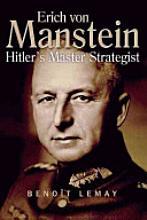
Reviewed by Steven Douglas Mercatante [1]
There is little doubt that Erich von Manstein had one of the finest military minds of the Second World War. Among his accolades, include, perhaps most famously, his role in creating the plan that lead to the spectacular fall of France in 1940. In addition, came his exploits leading Army Group Don in February and March 1943; when his brilliant "backhand" counterstroke not only brought stability to the German Eastern Front, following the loss of Stalingrad, but also forced the surging Red Army back on to its heels.
As well as his genius as an operational level commander, however there was also a dark side to Manstein that proved far from unique amongst the Wehrmacht's highest ranks during the Second World War. Manstein, as shown in Benoit Lemay's ERICH VON MANSTEIN: Hitler's Master Strategist, was deeply implicated in the Holocaust just as were the overwhelming majority of his peers in the Wehrmacht's officer corps. In spite of this reality, following the War Manstein and many of his former comrades denied the important role they had played in the genocidal slaughter of, in particular, Jews and Slavs across Eastern Europe. In this sense, Manstein stood as a symbol of everything that explained the German Wehrmacht's incredible tactical and operational level military prowess during the War, and its moral depravity.
In spite of Manstein's important role in the Second World War it has only been in the past few years that there has been a sustained examination of the man and, in particular, his assertion that he, like so many of his peers in the Wehrmacht was nothing more than an apolitical military professional or technician. Thus, as Manstein described in his memoirs, National Socialist ideological beliefs and the resultant Holocaust were not only abhorrent to him but something he simply lacked time to deal with; no less follow.
In the past few years however, more and more has emerged about men such as Manstein. This information has painted a far more complete picture of these men, their military faults and strengths and, most importantly, how much they not only shared Hitler's beliefs but also aided and abetted Hitler and his regime in the slaughter of tens of millions innocent human beings; particularly in Eastern Europe. In 2007 Marcel Stein produced one of the first truly complete looks at Manstein in his work Field Marshal von Manstein, The Janus Head, A Portrait. I reviewed Stein's work and found it to be a valuable addition to the available literature on the War. Stein's work filled important gaps in what was widely known about the War, added to what is still coming to light about the Wehrmacht's involvement in the Holocaust, and helped in countering decades of myths still prevalent today; more than sixty years after the War ended. In particular, Stein's work took a dim view of Manstein the man; especially because of his role in the Holocaust and subsequently denying the German army's responsibility for enabling and assisting in the Holocaust. However, Stein didn't stop there, he also painted a more realistic picture of Manstein the military leader whose undoubted episodes of near unmatched genius were paired with some highly questionable and controversial decisions. Stein paid special attention to the German response to the Sixth Army's encirclement at Stalingrad and in the planning for the July 1943 German attack on the Red Army's positions at Kursk.
In ERICH VON MANSTEIN: Hitler's Master Strategist Benoit Lemay has offered an at times complementary look at Manstein, for instance, in demonstrating Manstein's military genius in relation to two campaigns in particular: his plans for the Wehrmacht's Western European campaign of 1940 and Manstein's leadership of Army Group Don in Southern Russia during the winter of 1942-1943. In addition, and much like Stein, Lemay also covers in detail Manstein's at times brilliant leadership of the German 11th Army during the Crimean campaign of September 1941-July 1942. In addition, and like Stein, Lemay's work provides detailed insight into Manstein's role in the Holocaust, particularly during his command of the 11th Army, as well as his efforts to avoid his ultimate conviction as a war criminal following Germany's defeat. What is more, Lemay's work follows a similar largely chronological layout with only the discussion of the courtship of Manstein by the resistance to Hitler, placed in the book's second half, breaking from this convention. Unfortunately, and also much like Stein's work, Lemay's could use a few more maps; an omission in content that is particularly hard to understand in light of the unfamiliarity many in the Anglo-American world, even those who are relatively well-informed on the Russo-German War, have with the geographic locations in Eastern Europe where World War II was decided.
In spite of the aforementioned similarities with Stein's work there is much in Lemay's new book that enables his to stand alone vis a vis Stein; and more importantly act as an important counterpoint in the enduring debates surrounding Manstein's record. In fact, there are two areas in particular where Lemay's work differs quite notably from Stein's. First, in a military sense, Lemay is far less critical then Stein is of Manstein's decisions when those decisions proved controversial. For instance, Lemay largely backs Manstein's decision-making during the attempts to relieve the German Sixth Army at Stalingrad in November and December of 1942. This is not to say Lemay is uncritical of Manstein. Overall, however, he, unlike Stein, absolves Manstein of much of the responsibility for the failure to rescue the Sixth Army. Such a position more amenable to Manstein's is true in regards to Manstein's other operations during the War where Lemay's analysis tends to back Manstein's more controversial military decisions.
Second, in regards to Manstein's role in the Holocaust and resistance against Hitler, though Lemay is unequivocal in agreeing with Stein that Manstein held commands during the War that committed unspeakable war crimes, Lemay still takes a more traditional approach to Manstein's actions in regards to the plot against Hitler and Manstein's failure to become involved. For instance, Lemay hews to a more conventional Cold War era rationalization of Manstein's position by describing Manstein as representative of the Germano-Prussian military caste of his time, and thus duty bound to stand with Hitler. That said, Lemay does excoriate Manstein for being incredibly over-optimistic to the point of breaking with reality regarding Germany's chances in the War following Manstein's own dismissal by Hitler from the command of Army Group South in the spring of 1944. Furthermore, Lemay also goes on to speculate that in part this loyalty may have been a cynical product of Manstein's raw ambition to one day serve as the head of the OKH, German army high command, perhaps even more so then it may have stemmed from Manstein's purported views on duty. These are just some of the examples that can be found in Lemay's work where he, as does Stein, critically analyzes Manstein's decisions and/or his explanations/excuses and finds them lacking in both credibility and morality.
On the whole, Lemay's work can probably best be characterized as tacking a bit more toward the conventional wisdom on Manstein then does Stein. Lemay comes closer to Stein's conclusions than not on a number of important controversies which Manstein played a role in, and like Stein debunks Manstein's attempts to remove himself, and the Wehrmacht, from Nazi Germany's war of annihilation in Eastern Europe. That said, Lemay's work stands, on many levels, somewhere between Stein's comprehensive dismantling of Manstein's mystique and Manstein's own self-aggrandizing and misleading memoirs. In that sense, regardless of if you have read Stein's work, Lemay's is a must-read for those interested in not only gaining familiarity with a more moderate position on Manstein but also for all those who wish to understand Germany's primary effort in World War II, as well as its greatest commander.
1.Steven Douglas Mercatante's Why Germany Nearly Won, A New History of the Second World War in Europe, is currently scheduled for publication by ABC-CLIO's Praeger early in 2012. Why Germany Nearly Won not only explores how close Germany actually came to winning the Second World War, but also why Germany was defeated. This work stems from over two decades researching and studying the Second World War. Steven's writing in the historical field goes beyond his research, and draws upon his experience as a former history teacher, from his undergraduate studies in history at the University of Michigan, from his graduate work in history at Eastern Michigan University, and from his study of International Law at Michigan State University College of Law. Steven has been published numerous times over in the historical and financial/legal field, both online and in a scholarly journal with a 2008 article entitled; The Deregulation of Usury Ceilings, Rise of Easy Credit, and Increasing Consumer Debt, published in volume 53 of the South Dakota Law Review.


Post new comment